How to Go Fast Downwind in a Finn
Arkadii Kistanov
·
·
8 min read
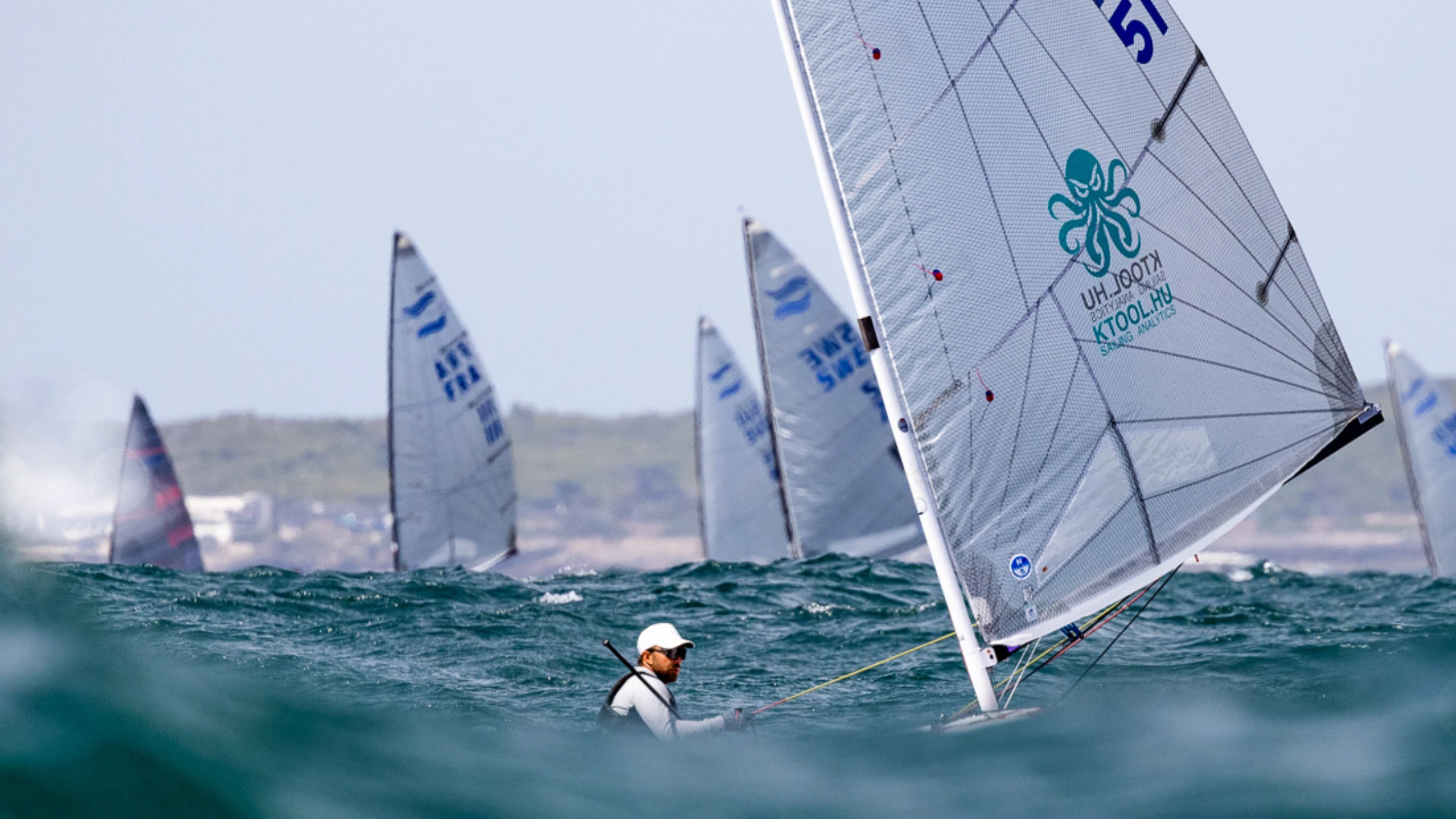
Many sailors I coach ask the same question: what is the fastest way to sail downwind in a Finn? This is my attempt to answer it clearly and practically.
Downwind speed in a Finn is not just about feeling fast. It comes from understanding how the sail works, choosing the right mode for the wind strength, and using heel, sheet and body movement to get more speed and VMG.
The Physics You Actually Need
To sail fast downwind, you first need a simple and correct picture of how the sail produces force.
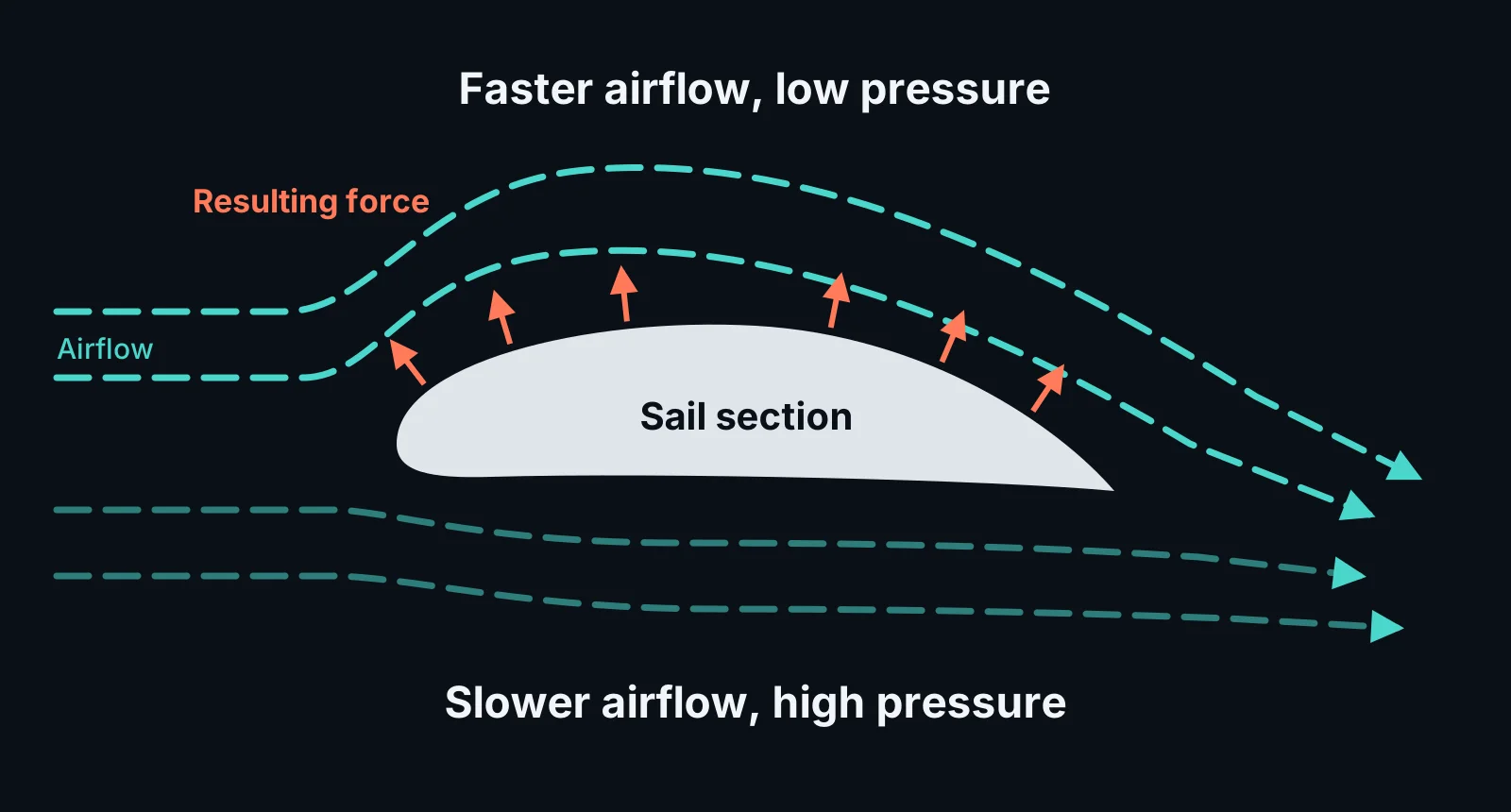
A sail works because of the pressure difference created by the airflow moving at different speeds across its two sides (the Bernoulli principle). As long as the flow stays attached, the sail generates useful aerodynamic force. Once the flow separates, the sail loses efficiency: drive drops, drag rises, and the boat slows down.
This is true upwind and downwind, even if the geometry downwind looks less intuitive.
A common mistake is to think downwind speed comes only from presenting sail area to the wind. In reality, a Finn is usually faster when the sailor keeps a stable, efficient airflow on the sail rather than simply pointing the bow at the leeward mark.
In practice, that means sailing in one of two active modes: broad reaching or by-the-lee. A long dead run can be tactically useful at times, but as a performance baseline it is usually slower.
The Three Downwind Modes
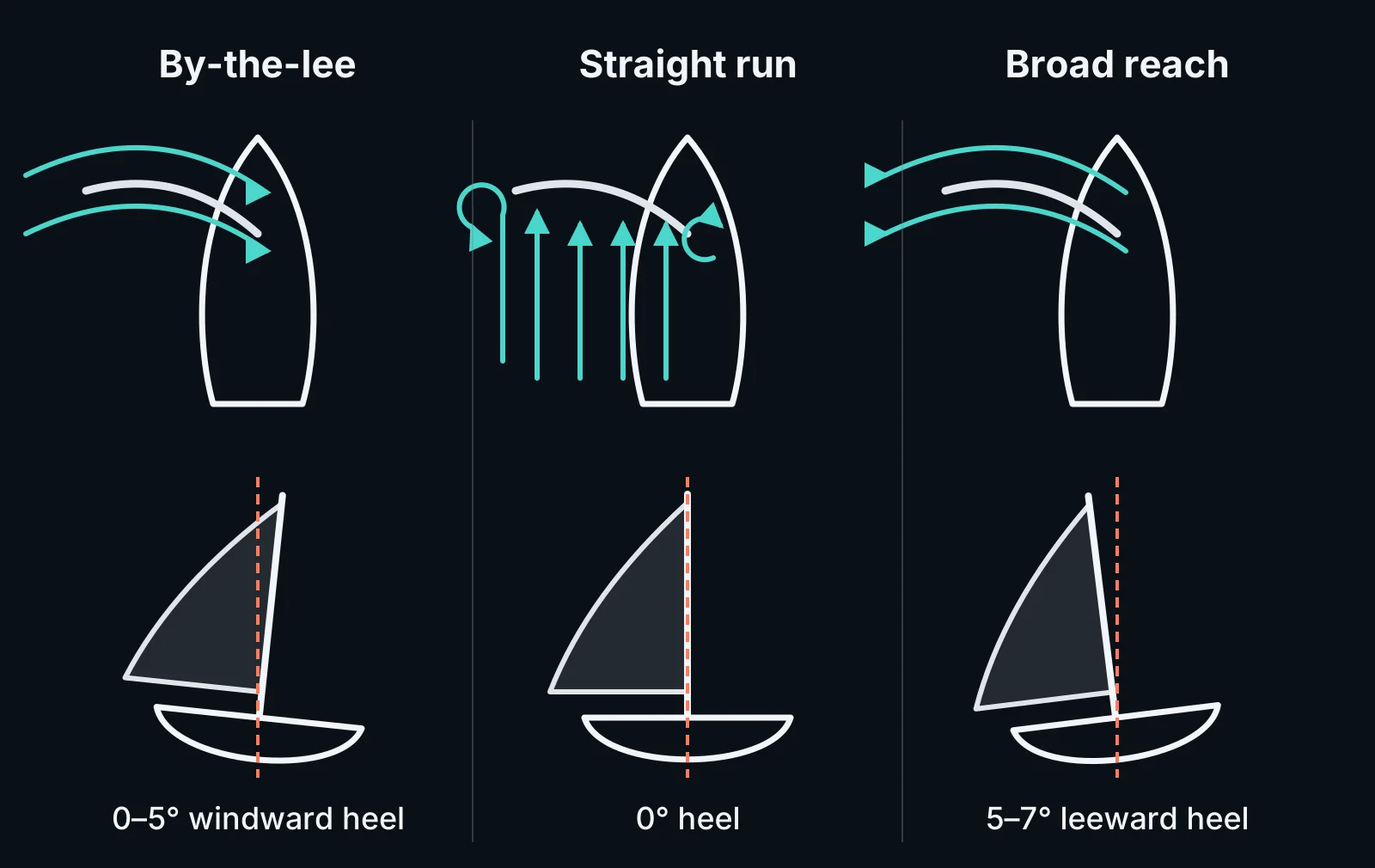
Broad reaching. The airflow is organised in the conventional way. The telltales stream aft, and the masthead windex points from the mast side toward the leech. The sail stays loaded and efficient while the boat is driven at speed.
By-the-lee. The flow pattern is reversed compared with broad reaching. The leech telltales show flow from leech toward luff, and the windex confirms the same pattern. This is a distinct mode, not a mistake or an unstable version of running.
Dead run. A straight run is useful tactically, for example to protect a lane, compress a fleet situation or approach a mark. Over a long period it is not the fastest mode, because the sail is less efficient and the boat loses the dynamic response available in broad reach or by-the-lee.
How to Identify Your Mode on the Water
Combine two references: the leech telltales and the masthead wind indicator.
If the telltales stream aft and the windex points from the mast toward the leech, you are broad reaching.
If the telltales stream from the leech toward the luff and the windex confirms the same direction, you are sailing by-the-lee.
If the two references disagree, or neither is stable, the flow is probably not organised well enough. The mode is unstable, the sail is not fully attached, and the boat is leaving speed on the table.
Vang, Sheet and Heel
Vang
Vang tension should support the mode you are trying to sail.
By-the-lee, the leech needs to stay alive and responsive. The sail should still work dynamically, but the boom must stay controlled enough for the rig to transmit the right amount of energy into the boat.
Broad reaching, vang tension is higher. The aim is to stop the upper leech opening too much and help the sail hold its energy without the flow spilling upward too easily.
Heel
Heel is one of the most underappreciated controls downwind.
Broad reaching, sail the boat flat or with a slight heel to leeward. Windward heel here is very slow. Induced drag and spanwise flow increase, the side forces on the daggerboard become less stable, and the hull loses its contact with the water, so the boat sits lower and struggles to start planing.
By-the-lee, sail the boat flat or with slight windward heel, typically around 3 to 5 degrees. That windward heel works like a reversed leeward heel, because the flow is arriving from the leech side.
Too much windward heel is always slow. On a straight line, keep it within 3 to 5 degrees.
Which Mode Is Faster?
In light and medium conditions, a well-controlled by-the-lee mode is often faster than passive broad reaching. It lets the leech pump legally, and the mast stops the airflow spilling upward, so more energy stays in the sail. This technique is very popular in the ILCA classes.
The Finn class rules allow pumping, rocking and ooching once the wind is above 10 knots and the Oscar flag is displayed. So in practice, once free pumping is on and the sailor can physically turn effort into acceleration, active pumping on a broad reach becomes the preferred high-power mode.
That only holds if the pumping is effective. If the sailor is working hard and the boat isn't responding, the effort is wasted.
As the wind rises further, load and fatigue climb again. In very strong breeze the theoretical power advantage of reaching can be cancelled out by control limits, fatigue and the difficulty of keeping clean, repeatable mechanics. In those conditions the best mode depends heavily on the sailor, the wave pattern and the ability to keep the boat free and stable.
The Logic of Transitions and S-Turns
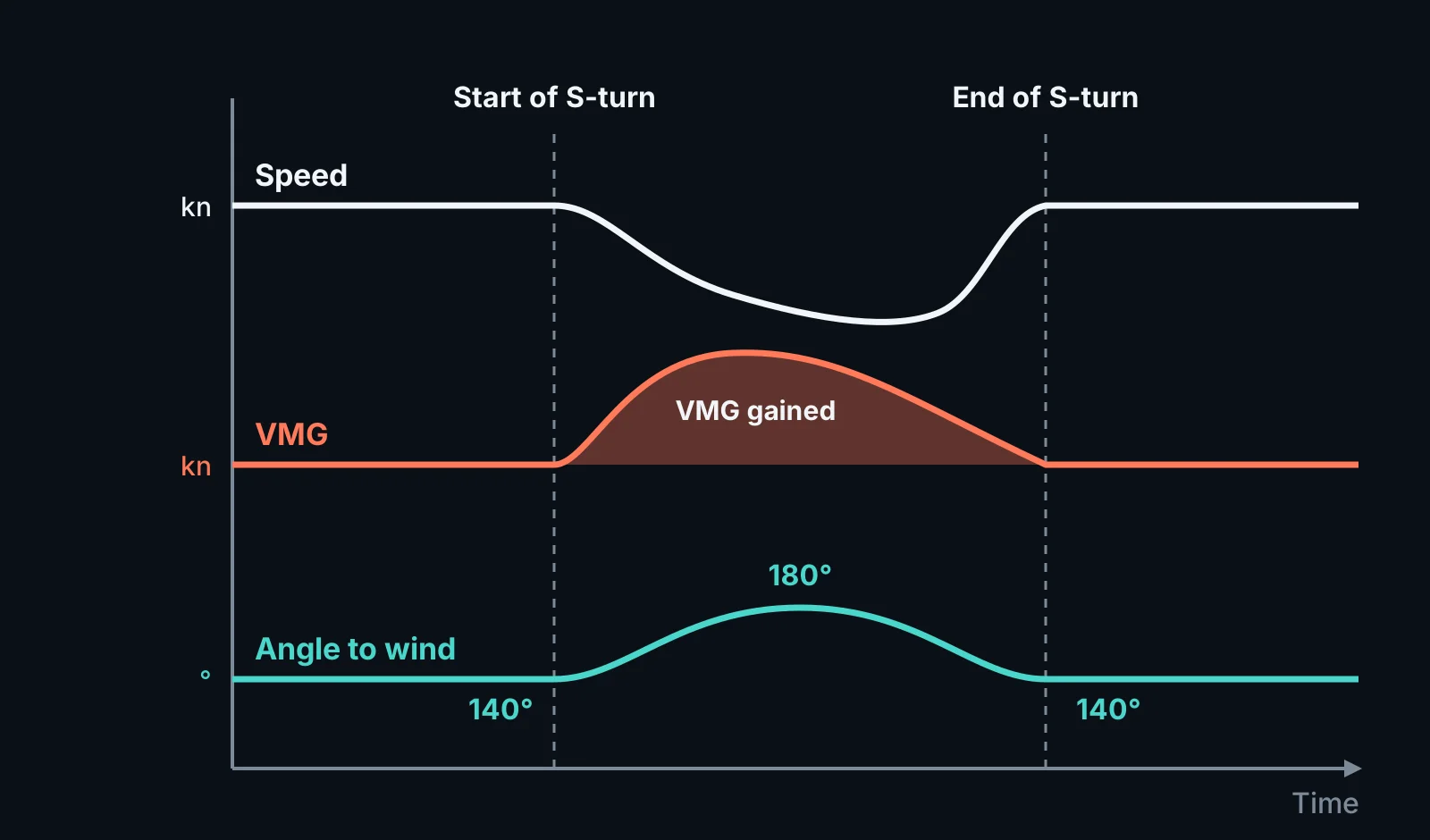
The purpose of a transition is to improve VMG. Moving the bow around is only the means.
For a transition to pay, two conditions must be met.
First, the boat must already be sailing close to its maximum speed in the current mode. Then the only way to increase VMG is to change course and go closer to the mark. If the boat isn't at maximum speed, there is no reason to transition. Sail it faster in its present mode first.
Second, the gain in downwind angle must outweigh the speed lost by turning and by disturbing the flow.
This is why good S-turns are difficult. During a transition, the apparent wind direction relative to the sail changes, the rig has to reorganise the flow, and the boat is always at risk of creating extra drag. The sailor's job is to let the boat change mode smoothly, quickly and with as little resistance as possible.
A useful way to think about it:
- If speed is near maximum, the only way to improve VMG is to sail slightly deeper.
- The boat has inertia, so speed does not drop instantly.
- That means VMG can briefly improve as the sailor goes deeper.
- The sailor then has to return to an efficient broad reach or by-the-lee mode before VMG decays below the baseline.
If the transition is slow, abrupt or poorly coordinated, the losses are bigger than the gain and the S-turn becomes expensive.
How to Steer Transitions
Transitions should be led by heel and sheet, not by the rudder.
To luff, first heel the boat to leeward, then trim the mainsheet. The boat heads up with less drag and less braking from the rudder.
To bear away, first roll the boat to windward, then ease the sheet. The boat turns down more naturally and the movement stays connected to the change in the sail.
If heel, sheet and heading changes are not synchronised, the boat slows down, and the transition shows up in the data straight away.
Data-Driven Training
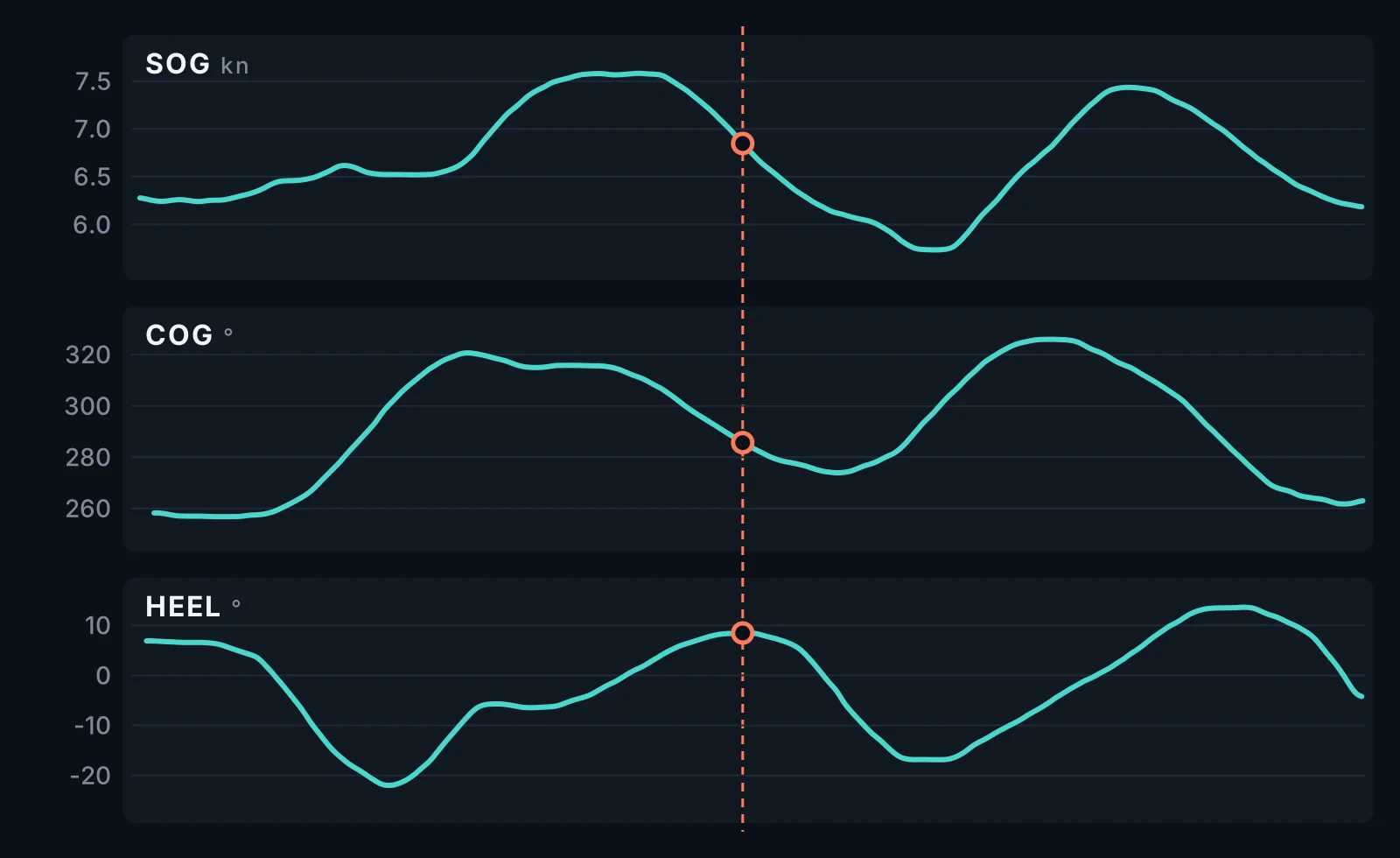
I use kTool Sailing Analytics with an onboard tracking device to analyse downwind performance and transitions. Average speed tells you very little. What matters is the sequence.
- Heel change. Heel changes first.
- Heading change. Heading responds immediately after.
- Speed response. Speed follows with only a small delay.
- VMG effect. VMG improves without a deep speed collapse.
That is what a good transition looks like. When it goes wrong, the order tells you why:
- Heading changes before heel: the sailor is steering too much with the rudder.
- Heel changes but heading reacts late: the boat is not being released properly.
- Heading changes but speed never responds: the maneuver is probably too aggressive, or the sail is not reorganising efficiently.
Free Pumping Analysis
When free pumping is allowed, I look for a very specific pattern. A strong pump should be short, create a clear acceleration, keep the heading steady and not break the overall mode of the boat.
If the sailor rolls from roughly 20 to 25 degrees of leeward heel back toward flat, course over ground stays broadly stable, and each pump produces a measurable speed increase, the mechanics are likely working.
If there is no acceleration after the effort, the pump is inefficient. The sailor is usually better off stopping, resetting the mode and saving energy.
This is one of the biggest advantages of data analysis. It tells you whether the work is producing speed or only producing fatigue.
Final Point
Fast downwind sailing in a Finn is the ability to move intelligently between modes, more than any one fixed technique.
You are fast if you understand the airflow, recognise whether you are broad reaching or by-the-lee, use heel and sheet to support the mode, transition only when the VMG logic is there, and use data to confirm your mechanics are really working.
That is how downwind speed becomes repeatable rather than accidental.
Arkadii Kistanov is kTool's CEO, a Finn sailor and coach. This article was first published in Finnfare, April 2026.
Good sailors train hard.The best ones train smart.
Start free — no cardRelated posts